
By Patty Wilber
I took Lucy hunting in 2023, (there’s a blog post!) and it was clear that her night vision was impaired, but it was also clear that she is not 100% blind after dusk as some research on LP/LP horses (which Lucy is) has suggested. (LP/LP means Lucy has two copies of the LP gene.) Other sources do indicate that LP/LP horses may have some night vision.

Lucy on the high line, Fall 2023
The reason that some sources have suggested that LP/LP horses are 100% blind at night is because of results like this:
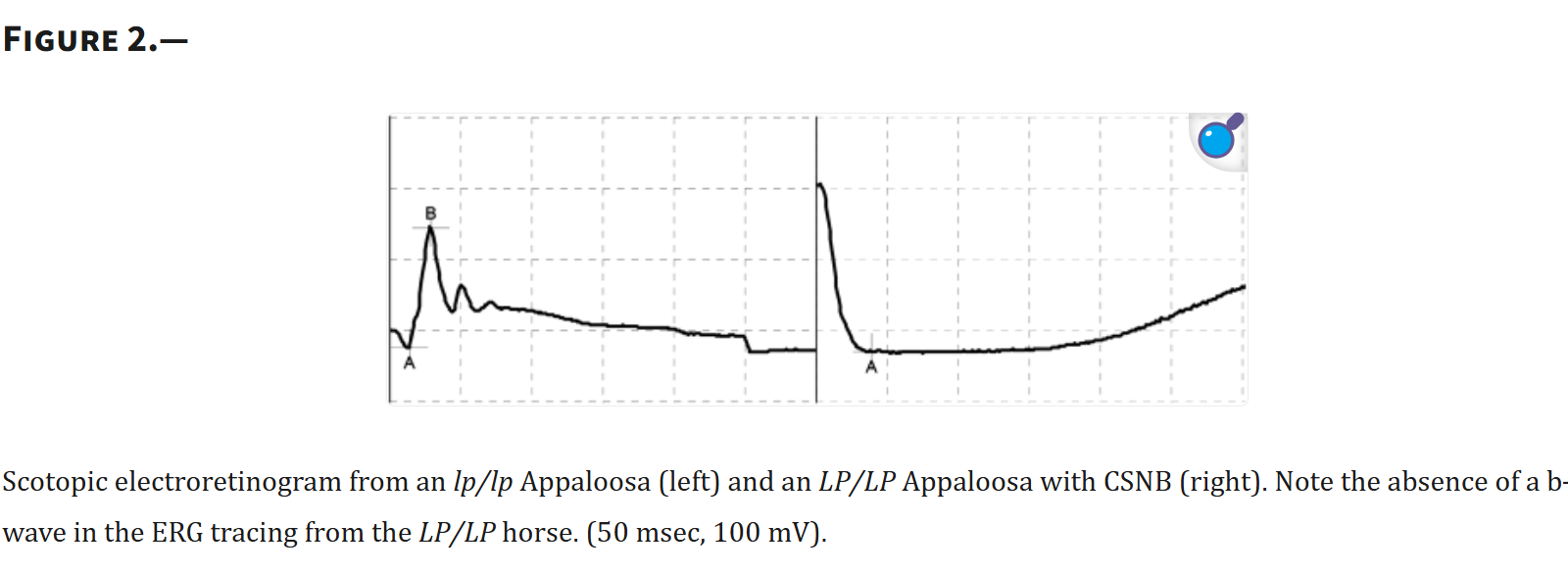
The presence of the A wave and lack of the B wave in the LP/LP horses indicates that the rods (cells that detect light in low conditions) are working (A wave), but that the signal can not get to the next level or the brain (lack of B wave), so the rod system fails.
So, even though the rod (cells that work in low light) system seems to be kaput in 100% of horses that are LP/LP, there are other mechanisms that might be responsible for the apparent variation in night vision.
- Horses have a well-developed tapetum lucidum. The tapedum lucidum is a reflective layer located behind the retina. It causes white eye shine in horses. (Reindeer show a golden eye shine and summer and a deep blue color in winter which enhances vision in low light conditions in the far north.) The tapetum reflects light that passes through the retina back to the cones and the rods, giving these cells a second chance to detect light. In horses with CSNB, the rod system doesn’t work, so the cones are the cells that benefit, and some horses may have tapeda lucida that are more effective than others. Unfortunately, the reflected light is more likely to benefit rods than cones, and only the cone system works in horses with CSNB. But….
- Some horses have cones that work better in dim light than others. Cones are the cells in the eye that provide color vision and sharpness. They normally work best in bright light. However, some horses have cones that work in fairly dim conditions. One gelding could still distinguish color at 0.02 cd/m² (candela per square meter) which is comparable to natural light levels during a dark moonlit night with some cloud cover. If some horses with CSNB have cones like this, they can not only see but can also distinguish color in dim light!
- Horses have really big eyes with pupils that dilate well to collect light in low conditions. There is no research to show that some horses have eyes that gather light better than others, but because eye morphology is variable, there is reason to suspect this may be true.
So, in summary, Lucy seems to be able to function somewhat in low-light conditions. Even though her rods cannot relay signals to her brain, she may have some combination of cones that work fairly well in low light, well-structured tapeta lucida, and/or eyes that gather more light through wide pupil dilation or overall anatomy. (She does have nice big eyes!)
My next foray into the LP gene will cover the mechanisms by which the gene causes both coat depigmentation and CSNB.
Happy Friday!


Cool learning tidbit!